7 AI Value Drivers Every Business Leader Must Leverage in 2026
Discover the 7 critical AI value drivers transforming businesses in 2026. Learn how productivity, profitability, and competitive advantage through AI implementation can revolutionize your operations.
Rita is CEO of Argeejay Inc., an AI consulting firm helping SMEs navigate AI adoption through strategic readiness assessments and implementation support. With expertise spanning project management, digital transformation, and AI strategy, she guides organizations from AI awareness to competitive advantage.
1/27/20268 min read
7 AI Value Drivers Every Business Leader Must Leverage in 2026
The question isn't whether your business should adopt AI, it's which AI value drivers will deliver the highest ROI for your specific operation. While competitors debate adoption timelines, forward-thinking organizations are already capturing market share through strategic AI implementation.
This guide breaks down seven proven value drivers that deliver measurable business impact, backed by implementation frameworks you can deploy immediately.
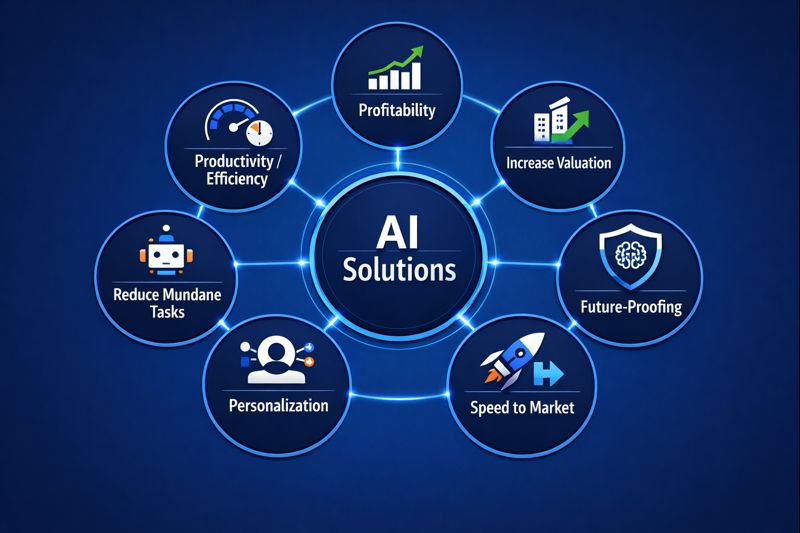
1. Productivity and Efficiency: The Multiplier Effect
What decision-makers need to know: AI doesn't just automate tasks, it multiplies human capability. The critical distinction lies in understanding the difference between task automation and cognitive augmentation.
The Real Impact
Organizations implementing AI-powered productivity tools report 35-50% time savings on knowledge work tasks. However, raw time savings tell only part of the story. The compound effect emerges when teams redirect reclaimed hours toward high-value activities that drive revenue and innovation.
Strategic Implementation:
Document Processing: AI-powered tools extract, categorize, and route information from contracts, invoices, and reports in seconds rather than hours. A mid-sized professional services firm reduced proposal preparation time from 8 hours to 45 minutes using AI document analysis.
Meeting Intelligence: AI assistants transcribe, summarize, and extract action items from meetings automatically. Teams save 6-8 hours weekly on meeting follow-up while improving accountability through automated task tracking.
Decision Support: AI analyzes multiple data sources simultaneously, providing real-time insights that would require days of manual analysis. Finance teams close books 40% faster with AI-assisted reconciliation and variance analysis.
Critical Success Factor
The productivity multiplier only materializes when organizations redesign workflows around AI capabilities rather than simply overlaying AI onto existing processes. Map your highest-value activities first, then architect AI solutions that eliminate bottlenecks preventing those activities from scaling.
2. Profitability: Direct Bottom-Line Impact
What CFOs care about: AI profitability drivers fall into three categories - cost reduction, revenue enhancement, and capital efficiency. Each requires different investment profiles and delivers returns on distinct timelines.
Quantifiable Profit Centers
Cost Optimization: AI identifies spending patterns, flags anomalies, and recommends optimization opportunities across operations. Supply chain AI reduces inventory carrying costs by 20-30% through demand forecasting accuracy improvements of 85%+.
Revenue Enhancement: Predictive analytics identify upsell and cross-sell opportunities with 3-4x higher conversion rates than manual approaches. Sales teams using AI-powered account intelligence close 25-40% more deals in the same timeframe.
Margin Protection: AI detects revenue leakage from billing errors, contract non-compliance, and operational inefficiencies. A manufacturing client recovered $2.3M annually in previously unbilled project variations through AI contract analysis.
Implementation Priority Matrix
Start with quick-win cost reductions that self-fund subsequent AI investments. Deploy revenue-enhancement AI once foundational data infrastructure exists. Reserve capital-efficiency projects for when organizational AI maturity supports complex multi-system integration.
ROI Timeline Reality: Operational efficiency AI delivers measurable returns in 60-90 days. Revenue-driving AI requires 4-6 months for data training and process refinement. Strategic transformation initiatives span 12-18 months but create sustainable competitive advantages.
3. Reduce Mundane Tasks: Free Your Talent
The hidden cost: Knowledge workers spend 40-60% of their time on repetitive, low-value tasks that drain engagement and fuel turnover. This isn't just an efficiency problem, it's a retention crisis.
Beyond Basic Automation
While Robotic Process Automation (RPA) handles structured, rule-based tasks, modern AI tackles semi-structured and unstructured work that previously required human judgment.
Email Management: AI categorizes, prioritizes, and drafts responses to routine inquiries. Customer service teams reduce response time from 4 hours to 15 minutes while handling 3x more volume.
Data Entry and Enrichment: AI extracts information from multiple formats - PDFs, images, emails, forms and populates CRM systems automatically. Sales teams spend 70% less time on administrative tasks and 70% more time selling.
Report Generation: AI assembles performance dashboards, management reports, and client deliverables from raw data sources. Marketing teams publish campaign performance reports in minutes instead of days.
The Talent Retention ROI
Organizations that eliminate mundane work through AI report 35% higher employee satisfaction scores and 28% lower voluntary turnover among high performers. The financial impact extends beyond replacement costs - engaged teams innovate faster and serve customers better.
Strategic Approach: Survey your team about their most frustrating repetitive tasks. Quick wins in mundane task elimination generate organizational momentum for larger AI initiatives while demonstrating leadership commitment to employee experience.
4. Personalization Through Data: The Experience Advantage
Market reality: Customers now expect personalization as standard, not premium service. Generic experiences feel broken, not neutral. AI transforms data into individualized interactions at scale.
From Segmentation to Individualization
Traditional segmentation groups customers into broad categories. AI personalization treats each interaction as unique, adapting in real-time based on behavior, preferences, and context.
Content Customization: AI analyzes user engagement patterns and dynamically adjusts website content, product recommendations, and communication cadence. E-commerce sites using AI personalization see 15-25% conversion rate improvements.
Service Adaptation: AI-powered chatbots and support systems reference complete interaction history, purchase patterns, and stated preferences to deliver contextually relevant assistance. Customer satisfaction scores improve 20-30 points when support feels truly personalized.
Product Configuration: AI guides customers through complex product selection by learning preferences through conversational interfaces. B2B companies using AI product advisors reduce sales cycle length by 35%.
Data Strategy Foundation
Personalization effectiveness directly correlates with data quality and integration depth. Organizations must invest in:
Unified customer data platforms that consolidate touchpoints.
Privacy-compliant data collection and governance frameworks.
Real-time data pipelines enabling instant personalization.
Feedback loops that continuously refine AI models.
Privacy Imperative: Personalization built on transparent data practices creates competitive advantage. Customers willingly share information when they experience clear value and maintain control. Organizations that respect privacy boundaries while delivering personalization earn lasting loyalty.
5. Increase Business Valuation Through Data Assets
What investors assess: Modern business valuation models assign significant multiples to data assets, AI capabilities, and algorithmic competitive advantages. Your data strategy directly impacts enterprise value.
The Valuation Framework
Data as Strategic Asset: Companies with proprietary datasets that enable AI-driven advantages command valuation premiums of 20-40% compared to similar businesses relying on generic data.
AI-Driven Business Models: Organizations generating revenue directly from AI products or AI-enabled services receive higher multiples because growth can scale without proportional cost increases.
Operational Intelligence: Businesses demonstrating superior operational metrics through AI-powered decision-making reduce perceived risk, lowering cost of capital and improving valuation.
Building Valuation Through Data
Proprietary Data Moats: Develop unique datasets through:
Customer interaction data that competitors cannot replicate.
Product performance data from IoT and connected devices.
Process optimization data from operational systems.
Market intelligence from proprietary research and analysis.
Monetization Pathways:
Direct: Data products, insights-as-a-service, API access.
Indirect: Superior customer targeting, reduced acquisition costs.
Strategic: New business models enabled by data capabilities.
Demonstrable AI ROI: Quantify and document AI-driven performance improvements. Investors value evidence-based AI impact over theoretical potential. Track metrics including:
Revenue per employee improvements from AI productivity gains.
Customer lifetime value increases from AI-powered retention.
Operational margin expansion through AI cost optimization.
Innovation velocity measured by time-to-market reductions.
6. Speed to Market: The Velocity Advantage
Competitive context: Product development cycles that once spanned years now complete in months. Service launches that required quarters now happen in weeks. AI compresses timelines without compromising quality.
AI Acceleration Mechanisms
Product Development: AI simulates thousands of design iterations, identifies optimal configurations, and predicts performance before physical prototyping. Manufacturing companies reduce development cycles by 40-60%.
Market Research: AI analyzes customer feedback, competitive intelligence, and market trends in real-time rather than quarterly cycles. Product teams make data-informed decisions daily instead of waiting for formal research results.
Content and Campaign Creation: AI generates multiple creative variations, tests messaging effectiveness, and optimizes campaigns continuously. Marketing teams launch campaigns 5x faster while improving performance through rapid iteration.
Regulatory and Compliance: AI screens products against regulatory requirements, flags potential issues, and suggests modifications during development rather than at launch. Pharmaceutical and medical device companies reduce regulatory delays by 6-12 months.
Strategic Time-to-Market Advantages
First-Mover Benefits: AI-accelerated development enables market entry ahead of competitors, capturing mindshare and establishing customer relationships before alternatives emerge.
Learning Advantages: Faster launch cycles create more market feedback iterations, allowing teams to learn and improve at accelerated rates. Organizations completing 10 product iterations learn exponentially more than competitors completing three.
Resource Efficiency: Compressing timelines reduces the carrying costs of development resources and opportunity costs of delayed revenue. Capital deployed generates returns months or years earlier.
Implementation Insight: Speed advantages compound. Organizations that compress one product cycle by 30% gain momentum that accelerates subsequent cycles. Early AI investment in development acceleration creates widening competitive gaps.
7. Future-Proofing and Competitive Advantage
Strategic imperative: AI isn't a project with completion dates, it's organizational capability requiring continuous development. Competitive advantage comes from superior AI maturity, not first adoption.
Building Sustainable AI Advantages
Organizational Learning: Companies that embed AI experimentation into culture develop pattern recognition for valuable applications. Teams identify opportunities competitors miss because AI thinking becomes instinctive rather than deliberate.
Data Network Effects: AI systems improve with use. Organizations accumulating more interaction data train better models, creating self-reinforcing advantages. Early AI adopters benefit from years of model refinement unavailable to late entrants.
Talent Magnetism: Companies known for AI sophistication attract top technical and business talent seeking career growth in emerging technologies. Talent advantages accelerate innovation and execution across all business functions.
The Competitive Moat Framework
Proprietary Algorithms: Develop AI models trained on unique datasets solving problems specific to your industry or business model. Generic AI tools provide commodity functionality; custom models create defensible advantages.
Process Integration: Competitive advantage comes from embedding AI throughout operations, not deploying isolated point solutions. Organizations with AI woven into 50+ processes outperform those with 5 showcase projects.
Partnership Ecosystems: Build relationships with AI vendors, research institutions, and technology partners that provide early access to emerging capabilities. Being first to leverage breakthrough AI creates temporary monopoly advantages.
Risk Mitigation
Future-proofing also means preparing for AI-driven disruption:
Scenario Planning: Model how AI might transform your industry from multiple vectors - customer expectations, competitor capabilities, regulatory changes, and technology breakthroughs.
Portfolio Diversification: Invest across multiple AI applications and vendors to avoid single-point dependencies and maintain flexibility as technologies evolve.
Governance Infrastructure: Establish AI ethics frameworks, risk management protocols, and compliance structures that scale with AI adoption. Regulatory requirements will intensify; early investment in governance creates competitive advantage.
From Strategy to Implementation: Your Next Steps
Understanding AI value drivers intellectually differs fundamentally from capturing value operationally. The gap between awareness and impact closes through structured implementation supported by expertise.
Critical Implementation Realities:
Start with Strategy: Successful AI implementation begins with business strategy, not technology selection. Define specific value drivers aligned with strategic priorities, quantify expected impacts, and establish success metrics before evaluating tools.
Build Foundations First: AI requires data infrastructure, process documentation, and change management capabilities. Organizations rushing to deploy AI without foundations experience 70%+ project failure rates. Those investing in prerequisites first achieve 80%+ success rates.
Expect Learning Curves: AI implementation involves experimentation, iteration, and occasional setbacks. Organizations that treat early AI projects as learning investments rather than guaranteed wins develop sustainable AI capabilities. Failures teach critical lessons; avoiding experimentation guarantees irrelevance.
Invest in Capability Building: Technology purchases don't create AI advantage - organizational capability does. Invest equally in technology, talent development, and process transformation.
Take Action: AI Readiness Assessment and Discovery Call
You've identified the value drivers AI offers. The question now is which drivers deliver the highest impact for your specific business context, and what implementation pathway maximizes ROI while managing risk.
Every successful AI implementation starts with clarity about:
Current operational maturity and readiness for AI adoption.
Highest-value use cases aligned with strategic priorities.
Resource requirements and realistic timelines.
Risk mitigation strategies and governance frameworks.
Change management approaches ensuring organizational adoption.
Book your AI Implementation Discovery Call to work through a structured assessment of your AI readiness and opportunity landscape. During this 60-minute strategic session, we'll:
✓ Evaluate your current operational readiness for AI implementation.
✓ Identify top 3-5 use cases with the highest ROI potential for your business.
✓ Map dependencies, prerequisites, and potential roadblocks.
✓ Develop a phased implementation roadmap with clear milestones.
✓ Discuss investment requirements and expected returns across timeframes.
✓ Address specific concerns about data privacy, security, and governance.
The organizations winning with AI aren't necessarily first movers, they're strategic implementers who connect technology capabilities to business value drivers with precision.
[Book Your AI Implementation Discovery Call → Click here]
Don't let another quarter pass while competitors capture AI advantages. The cost of delayed action compounds daily as others establish data moats, train better models, and capture market position.
Your AI transformation starts with one strategic conversation.
Turning potential into delivery, one project at a time
My Social Media Handles
CONTACT ME
SUBSCRIBE TO MY NEWSLETTER
© 2026. All rights reserved.
Rita Etim operates under Argeejay Inc., a federally registered corporation in Canada.